
Advanced Technologies
At Gaiagen, we employ sophisticated scientific equipment to develop and test our solutions:
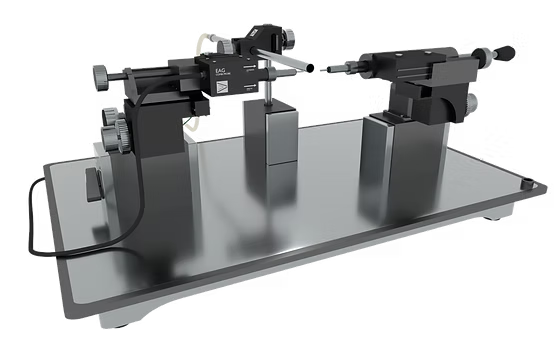
Electroantennogram (EAG)
Electrophysiology is a technique that quantitatively assesses the response of the olfactory system to odour stimuli. At Gaiagen, we measure these responses with our in-house Electroantennogram.
Electroantennography is usually performed by removing an antenna from the insect and inserting two chloride silver wires onto the two ends, then amplifying the voltage between them while applying an odour puff to see a deflection.
We apply this technique to screen insect pheromones by examining the responses to fractions of a compound mixture separated using gas chromatography.
Electroantennography is usually performed by removing an antenna from the insect and inserting two chloride silver wires onto the two ends, then amplifying the voltage between them while applying an odour puff to see a deflection.
We apply this technique to screen insect pheromones by examining the responses to fractions of a compound mixture separated using gas chromatography.
Gas Chromatograph (GC)
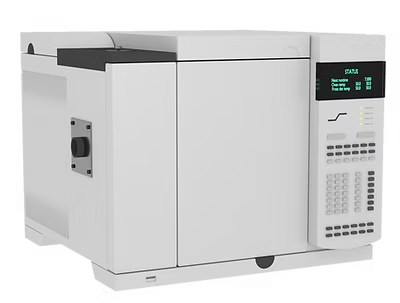
At Gaiagen, we are equipped with a Gas Chromatograph that is an essential instrument for analysing the various components present in a sample.
The analysis that the Gas Chromatograph performs is called gas chromatography. A sample solution is first injected into the instrument. It then enters a stream which carries the sample into a separation tube in its gaseous state.
The various compounds present in the sample can then be separated inside the tube. Gas chromatography is also known as vapour-phase chromatography (VPC) or gas-liquid partition chromatography.
The analysis that the Gas Chromatograph performs is called gas chromatography. A sample solution is first injected into the instrument. It then enters a stream which carries the sample into a separation tube in its gaseous state.
The various compounds present in the sample can then be separated inside the tube. Gas chromatography is also known as vapour-phase chromatography (VPC) or gas-liquid partition chromatography.
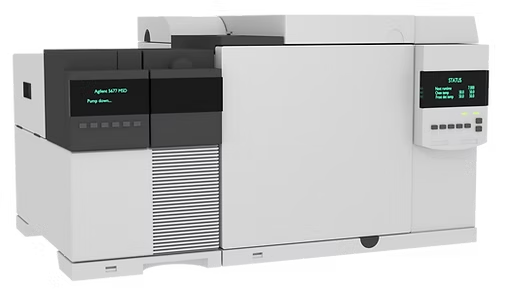
Gas Chromatograph-Mass Spectrometer (GCMS)
Our Gas Chromatograph - Mass Spectrometer merges the features of gas chromatography and mass spectrometry to analyse compounds with relatively low molecular weights.
Once the compounds are separated by volatilising the sample using the Gas Spectrometer, they are ionised by the Mass Spectrometer. The ions are then separated on the basis of their mass-to-charge ratios.
When analysed, using the compound as a function, the graphical peaks are proportional to the corresponding compounds. This information is visually displayed and can be recorded on the computer.
Once the compounds are separated by volatilising the sample using the Gas Spectrometer, they are ionised by the Mass Spectrometer. The ions are then separated on the basis of their mass-to-charge ratios.
When analysed, using the compound as a function, the graphical peaks are proportional to the corresponding compounds. This information is visually displayed and can be recorded on the computer.
High Performance Liquid
Chromatograph (HPLC)
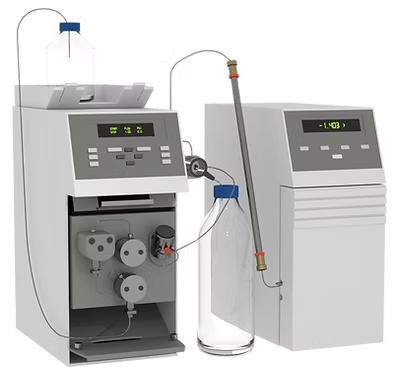
Our state-of-the-art laboratory is equipped with a High-Performance Liquid Chromatograph that separates, identifies and quantifies compounds in a sample as low as parts per trillion.
Pumps are used to pass pressurised solvents containing the sample through a column with a solid absorbent. Each compound interacts uniquely with the absorbent creating varied flow rates and are separated as they flow out of the column.
We use this technique to separate insect hormones and pheromones during our research and analyses.
Pumps are used to pass pressurised solvents containing the sample through a column with a solid absorbent. Each compound interacts uniquely with the absorbent creating varied flow rates and are separated as they flow out of the column.
We use this technique to separate insect hormones and pheromones during our research and analyses.
Y-Tube Olfactometer
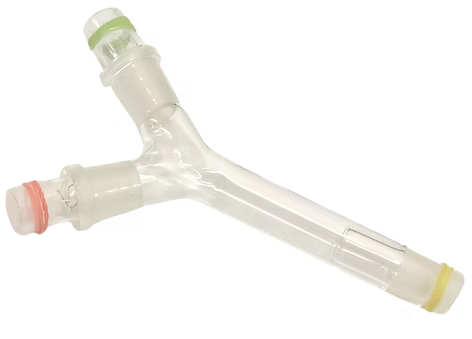
Our facility is equipped with Y-Tube Olfactometers of varied sizes that test responses of various insects to plant volatiles.
An adult insect is released at the base of the Y-Tube. A gentle flow of air is passed through one fork of the Y-Tube, while an attractant/repellent is passed through the other fork. The insect walks upwind to the end of one of the forks.
We use this technique to understand and measure the effectiveness of an attractant or repellent.
An adult insect is released at the base of the Y-Tube. A gentle flow of air is passed through one fork of the Y-Tube, while an attractant/repellent is passed through the other fork. The insect walks upwind to the end of one of the forks.
We use this technique to understand and measure the effectiveness of an attractant or repellent.
Multi-choice Olfactometer
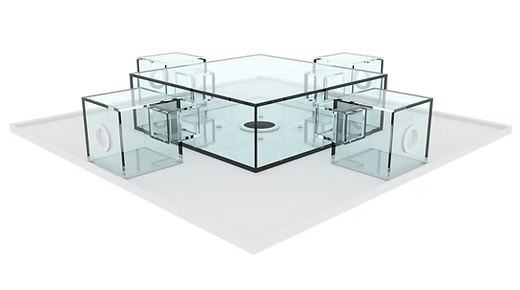
We rely on Multi-Choice Olfactometers of numerous sizes to study the responses of the insect to multiple odours simultaneously.
Each arm of the Multi-Choice Olfactometer is connected too a different odour source. The insect being observed will respond most favourably to the odour that it most prefers or is attracted to.
This technique helps us understand and measure the effectiveness of multiple attractants or repellents.
Each arm of the Multi-Choice Olfactometer is connected too a different odour source. The insect being observed will respond most favourably to the odour that it most prefers or is attracted to.
This technique helps us understand and measure the effectiveness of multiple attractants or repellents.
Experimental Chambers
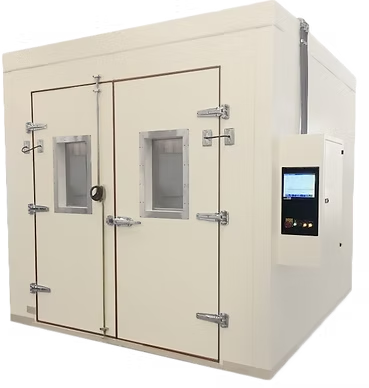
The experimental chambers that are housed inside our facility are specifically designed to aid experiments with different types of insects taking into consideration their behaviors and by providing a uniform environment to produce harmonized results.
This chambers is created following standard testing chamber designs with necessary customisations to meet the requirements of specialised product evaluations and behaviour studies.
This chambers is created following standard testing chamber designs with necessary customisations to meet the requirements of specialised product evaluations and behaviour studies.
Wind Tunnel
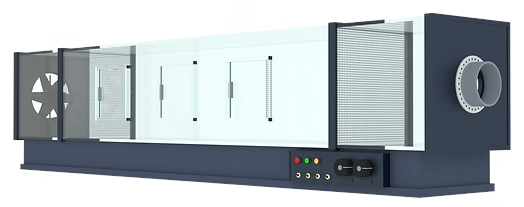
We study insect orientation and flight with regards to visual and odour stimulus using our wind tunnels. The technique is applied to observe and study insect behaviour when exposed to pheromones or any other attractants.
The infrared absorbing walls merged with the infrared LED illuminators makes tracking insects manageable in the dark. The wind tunnel can also be used to track insects in the day. The wind tunnel also comes in a wide range of sizes depending on the insect being observed.
The infrared absorbing walls merged with the infrared LED illuminators makes tracking insects manageable in the dark. The wind tunnel can also be used to track insects in the day. The wind tunnel also comes in a wide range of sizes depending on the insect being observed.
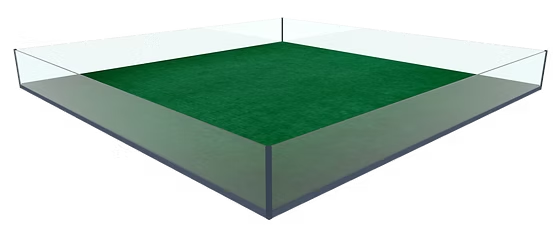
Testing Arenas
Our facility boasts of spacious and well equipped testing arenas where our scientists observe, study and find insights about a wide range of agricultural and urban insects.
The research that’s undertaken inside these testing arenas helps us develop entomological solutions that find an application in the agricultural, urban and industrial landscapes.
The research that’s undertaken inside these testing arenas helps us develop entomological solutions that find an application in the agricultural, urban and industrial landscapes.